

A pregnant woman in her third trimester presenting with painless vaginal bleeding, with foetal blood vessels running across or near the internal cervical os seen on colour Doppler.
Description
Vasa praevia is a rare obstetric complication where the foetal blood vessels traverse the foetal membranes across or near the internal os of the cervix. These vessels are vulnerable to rupture when the membranes rupture, as they are unsupported by the umbilical cord or placental tissue. It is a significant cause of foetal morbidity and mortality, especially if not diagnosed before the onset of labour.
Pathogenesis
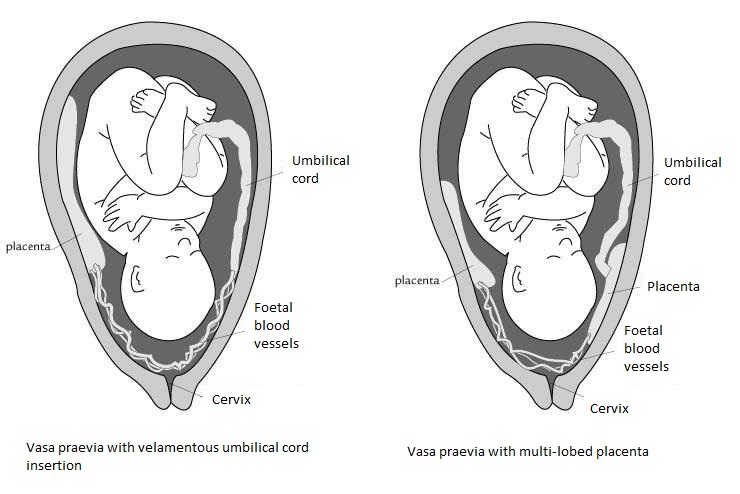
Vasa praevia occurs due to the malposition of the foetal vessels. During embryogenesis, if the blood vessels from the foetus to the placenta travel away from the umbilical cord, they can be laid over the cervical os. When the membranes rupture during labour, these vessels are at risk of compression or tearing, leading to acute foetal haemorrhage. If these foetal vessels rupture the bleeding is from the foetoplacental circulation, and foetal exsanguination will rapidly occur, leading to foetal death.
Subtypes
- Type I: Results from velamentous insertion of the umbilical cord. The vessels run between the foetus and the placenta.
- Type II: Occurs with bi-lobed or succenturiate-lobed placentas. The vessels run between the two lobes of the placenta.
Epidemiology, Risk Factors & Associations
- 1 in 2500 to 5000 pregnancies.
- Multiple gestations increases risk
- Bilobed or succenturiate-lobed placenta increases the risk (40% of cases).
- Low-lying placenta or placenta praevia associated with a higher incidence.
- In-vitro fertilisation (IVF) increases risk due to higher incidences of abnormal placentation (15%).
Clinical Features
- Classic triad: membrane rupture, painless vaginal bleeding (typically during labour) and foetal bradycardia or death
- Sinusoidal heart rate pattern: Pathognomonic feature on foetal monitoring due to foetal anaemia.
Complications
- Risk of foetal death: Up to 60% if undiagnosed prior to labour.
- Foetal hypoxia and neurological impairment due to rapid blood loss.
Pathological Features
Histopathology
- Macroscopic: Absence of Wharton’s jelly leading to exposed vessels.
- Microscopic: Normal foetal blood vessels but lacking the protective surrounding.
Radiological Features
US
- Aberrant vessels overlying the internal cervical os
- Colour Doppler: Flow of the vessels running across the cervix.
- B-mode: Visualisation of abnormal vessel course.
Grading and Staging
- No specific grading or staging system for vasa praevia.
Diagnosis
- Transabdominal colour Doppler is the primary diagnostic tool.
- Painless vaginal bleeding in the third trimester can be a clue, but imaging is essential for diagnosis.
Differential Diagnosis
Radiologically-based
- Marginal placenta praevia: Where prominent maternal vessels are appreciated at the edge of the placenta.
Clinically-based
- Bloody show: Normal bloody mucous discharge before labour. Differentiated by lack of foetal distress and different ultrasound findings.
Management
- Elective caesarean section before the onset of labour. Immediate caesarean section if diagnosed during labour.
- Referral to a maternal-foetal medicine specialist at a tertiary care hospital for further management.