

Overview
The inguinal lymph node can be subdivided into the superficial and deep lymph nodes and collectively drains the anal canal (below the pectinate line), the skin below the umbilicus, lower extremity, scrotum, vulva, glans penis, and clitoris. The lymph node’s primary function is to filter for harmful substances as lymphatic fluids travel through its cortex, paracortex, and medulla.
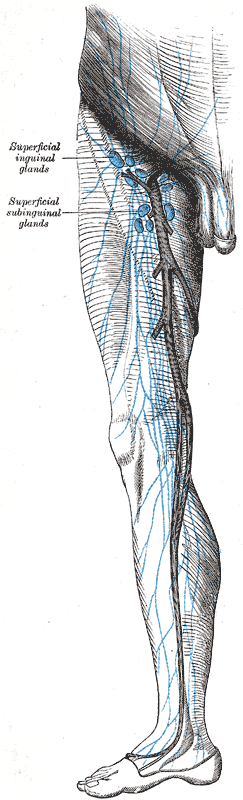
Structure
Superficial lymph nodes
- Inguinal lymph nodes that form a chain immediately below the inguinal ligament.
- Lie deep to the fascia of Camper that overlies the femoral vessels at the femoral triangle
- There are approximately ten superficial lymph nodes which can divided into three groups, named in according to its relation to the saphenous opening:
- Inferior – inferior of the saphenous opening of the leg, receives drainage from the lower legs
- Superolateral – on the side of the saphenous opening, receives drainage from the side buttocks and the lower abdominal wall.
- Superomedial – located at the middle of the saphenous opening, receives drainage from the perineum and genitals.
- Drains to: These lymph nodes eventually drain to the deep inguinal lymph nodes. Inguinal lymph nodes may normally be up to 2 cm in size.
Deep lymph nodes
- There can be three, four or five deep inguinal lymph nodes.
- They lie medial to the femoral vein under the cribriform fascia.
- Cloquet’s node (or Rosenmuller’s node) – The uppermost node in the groin, located under the inguinal ligament, may also be considered the lowest of the external iliac lymph nodes and therefore a potential sentinel lymph node.
- Drains to: The deep inguinal lymph nodes drain superiorly to the external iliac lymph nodes, then to the pelvic lymph nodes and on to the paraaortic lymph nodes