

A nerve plexus located on the posterolateral pelvic wall, on the anterior surface of the piriformis muscle. It supplies the skin and muscles of the pelvis and lower limb.
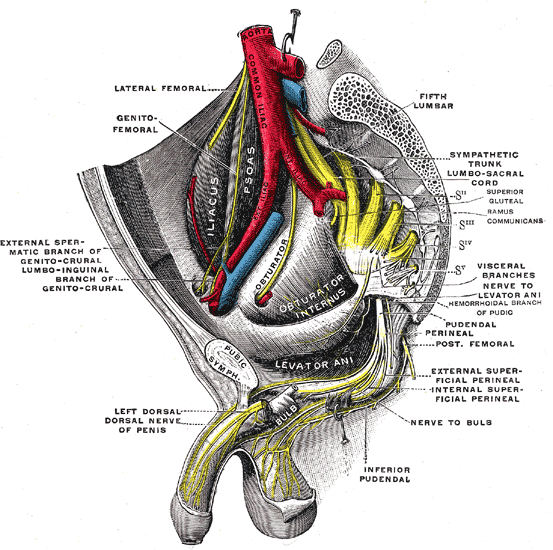
Gross anatomy
- Formed by anterior rami of spinal nerves S1 – S4
- Also receives contributions from lumbosacral trunk L4 – L5
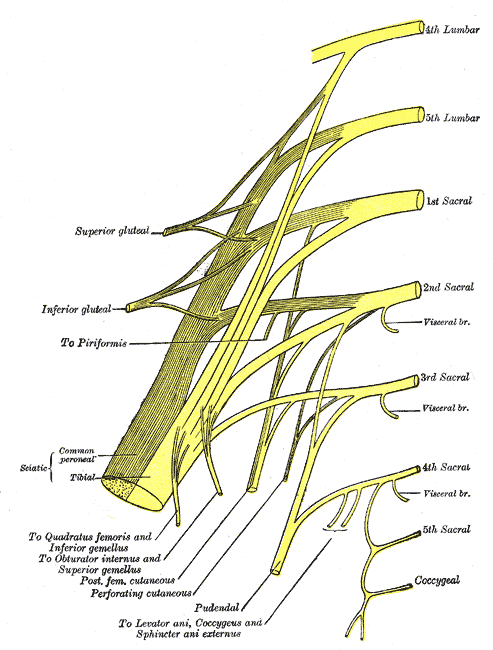
Course & Relations
- At each vertebral level, paired spinal nerves exit the spinal cord via the interverebral foramina
- Each nerve divides into anterior and posterior rami
Branches
Superior Gluteal Nerve
- Roots: L4, L5, S1.
- Course:
- Leaves pelvis posteriorly via the greater sciatic foramen, entering the gluteal region superior to the piriformis muscle.
- It ascends between the gluteus minimus and gluteus medius
- Motor Functions: Innervates the gluteus minimus, gluteus medius and tensor fascia lata.
- Sensory Functions: None.
- Relations: Accompanied by superior gluteal artery and vein
Inferior Gluteal Nerve
- Roots: L5, S1, S2.
- Course:
- Leaves the pelvis posteriorly via greater sciatic foramen, entering the gluteal region inferior to the piriformis muscle.
- Motor Functions: Innervates gluteus maximus.
- Sensory Functions: None.
- Relations: Accompanied by inferior gluteal artery and vein
Sciatic Nerve
Major nerve of the lower limb and largest nerve in the body. It is a thick, flat band
- Roots: L4 – S3
- Course:
- Leaves the pelvis posteriorly and enters the gluteal region, via the greater sciatic foramen, inferior to the piriformis muscle.
- It descends in an inferolateral direction, crossing the posterior surfaces of superior gemellus, obturator internus, inferior gemellus and quadratus femoris.
- It enters the posterior thigh by passing deep to the long head of the biceps femoris.
- Branches:
- Branches to the hamstring muscles (biceps femoris, semitendinosus, semimembranosus)
- Branches to the adductor magnus
- Terminates:
- Apex of popliteal fossa, bifurcating into tibial and common fibular nerves
- Motor Functions:
- Tibial portion – Innervates the muscles in the posterior compartment of the thigh (apart from the short head of the biceps femoris), and the hamstring component of adductor magnus. Innervates all the muscles in the posterior compartment of the leg and sole of the foot.
- Common fibular portion – Short head of biceps femoris, all muscles in the anterior and lateral compartments of the leg and extensor digitorum brevis.
- Sensory Functions:
- Tibial portion: supplies the skin of the posterolateral leg, lateral foot and the sole of the foot.
- Common fibular portion: supplies the skin of the lateral leg and the dorsum of the foot.
- Variants:
- Division in the pelvis with
- Common peroneal nerve piercing piriformis muscle and tibial nerve exiting below
- Common peroneal nerve travelling above piriformis muscle and tibial nerve below
- Common peroneal nerve travelling above piriformis muscle and tibial nerve piercing piriformis muscle
- Both common peroneal nerve and tibial nerve travelling below piriformis muscle separately
- Sciatic nerve courses over the piriformis muscle
- Sciatic nerve pierces piriformis muscle
- Division in the pelvis with
Posterior Femoral Cutaneous
- Roots: S1, S2, S3
- Course:
- The posterior cutaneous nerve of thigh leaves the pelvis via the greater sciatic foramen, entering the gluteal region inferior to the piriformis muscle.
- It descends deep to the gluteus maximus and runs down the back of the thigh to the knee.
- Motor Functions: None
- Sensory Functions: Innervates the skin on the posterior surface of the thigh and leg. Also innervates the skin of the perineum.
Pudendal Nerve
- Roots: S2, S3, S4
- Course:
- This nerve leaves the pelvis via the greater sciatic foramen, then re-enters via the lesser sciatic foramen.
- It moves anterosuperiorly along the lateral wall of the ischiorectal fossa, and terminates by dividing into several branches.
- Motor Functions: Innervates the skeletal muscles in the perineum, the external urethral sphincter, the external anal sphincter, levator ani.
- Sensory Functions: Innervates the penis and the clitoris and most of the skin of the perineum.