

Overview
The triceps brachii is a three-headed muscle, wholly comprising the posterior compartment of the arm and spanning virtually the entire length of the humerus. It is primarily involved in extension of the elbow joint.
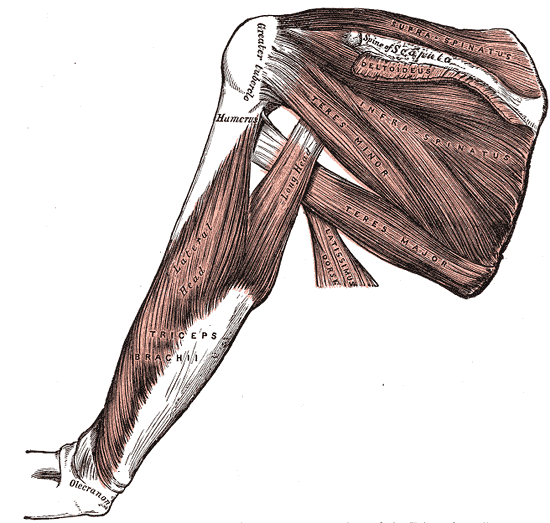
Origins
- Long head – infraglenoid tubercle of the scapula, a roughed area at the inferior margin of the glenoid fossa
- Medial head – posterior surface of the humerus (inferior to radial groove)
- Lateral head – posterior surface of the humerus (superior to radial groove), a narrow linear ridge.
Insertion
All three muscle bellies converge onto a common tendon which inserts onto the olercranon of the ulnar and fascia of forearm.
- Laterally, a band of fibres continues inferiorly over the anconeus muscle to blend with antebrachial fascia of the forearm.
Action
- Elbow joint – extension of the forearm
- Shoulder joint – extension and adduction of the arm (long head)
Innervation
Innervated by the radial nerve which originates from the posterior cord of the brachial plexus (roots: C5-T1), which gives off separate branches for each tricep head:
- C6 root – lateral head
- C7 root – long head
- C8 root – medial head
Arterial Supply
- Deep brachial artery – branch of the brachial artery
- Superior ulnar collateral artery – branch of the brachial artery
- May also receive supply from branches of the posterior circumflex humeral artery – arises from the axillary artery
Relations
- The superior portion of the long head of triceps is covered by the posterior border of the deltoid muscle.
The long head of the triceps forms three distinct anatomical spaces with the teres major, teres minor and the humerus:
- Upper triangular space – bound by teres minor and subscapularis superiorly, teres major inferiorly and the long head of triceps laterally. This space allows the passage of the circumflex scapular artery and vein from the axillary region to the scapular region
- Lower triangular space (triangular interval) – bound by teres major superiorly, the long head of triceps medially and the humerus laterally. This space is a conduit between the posterior and anterior compartments of the arm, which allows passage of the radial nerve and the deep brachial vessels
- Quadrangular space – bound by subscapularis and teres minor superiorly, teres major inferiorly, long head of triceps medially, and the surgical neck of humerus laterally. This space allows the axillary nerve and the posterior circumflex humeral artery and vein to pass from the axillary region to the posterior region of the shoulder