

Overview
A major peripheral nerve of the upper limb
- Sensory functions: Gives rise to the upper lateral cutaneous nerve of arm, which innervates the skin over the lower deltoid (‘regimental badge area’).
- Motor functions: Innervates the teres minor and deltoid muscles
- Deltoid – abduction of the arm after action from the supraspinatus has already reached 15 degrees
- Teres minor – lateral rotation and also participates in maintaining the stability of the glenohumeral joint
Origin

Arises in the axilla from the posterior cord of the brachial plexus, containing fibres originating from the C5 and C6 nerve roots.
Course
- In the axilla, the axillary nerve is located posterior to the axillary artery and anterior to the subscapularis muscle.
- It then winds from anterior to posterior around the neck of the humerus, exiting the axilla with the posterior circumflex artery and vein at the inferior border of subscapularis via the quadrangular space
- The axillary nerve then passes medially to the surgical neck of the humerus, where it divides into three terminal branches

Branches
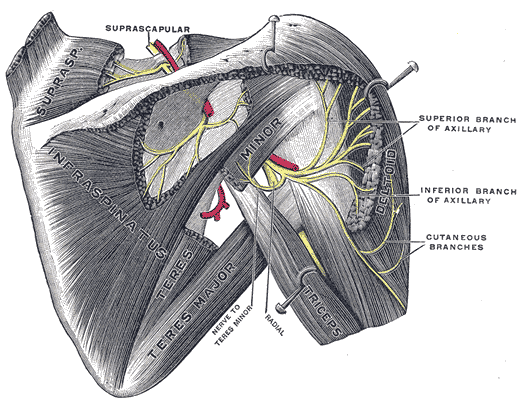
- Posterior terminal branch – pierces the deep fascia and continues as the superior lateral cutaenous nerve of arm, which sweeps around the posterior border of the deltoid and supplies the skin over the lower two-thirds of the posterior part of this muscle, as well as that covering the long head of triceps brachii.
- Provides motor innervation to the posterior aspect of the deltoid muscle and teres minor.
- After innervating the teres minor, it gives off the upper lateral cutaneous nerver which innervates the skin over the inferior lateral deltoid region called the regimental badge area
- The motor branch of the long head of the triceps brachii arises, on average, a distance of 6 mm (range 2–12 mm) from the terminal division of the posterior cord termination
- Anterior terminal branch – winds around the surgical neck of the humerus, beneath the deltoid muscle, with the posterior humeral circumflex vessels. It continues as far as the anterior border of the deltoid to provide motor innervation to the anterior aspect of the deltoid muscle. It terminates with cutaneous branches to the anterior and anterolateral shoulder.
- Articular branch – supplies the glenohumeral joint
Quadrangular Space
The quadrangular space is a gap in the muscles of the posterior scapular region. It is a pathway for neurovascular structures to move from the axilla anteriorly to the posterior shoulder and arm. It is bounded by:
- Superior – inferior aspect of teres minor
- Inferior – superior aspect of teres major
- Lateral – surgical neck of humerus
- Medial – long head of triceps brachii
- Anterior – subscapularis
The axillary nerve and posterior circumflex humeral artery and vein pass through the quadrangular space.