

Overview
The ethmoid bone is one of the 8 bones of the cranium. It is a small unpaired cuboidal bone with a relatively spongy texture, located in the midline of the anterior cranial fossa. It is situated at the roof of the nasal cavity, within the paranasal sinuses between the two orbital cavities. It forms a significant component of the upper nasal cavity, nasal septum and medial orbital wall.
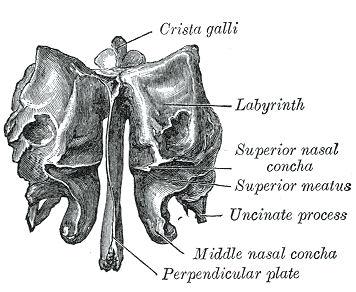
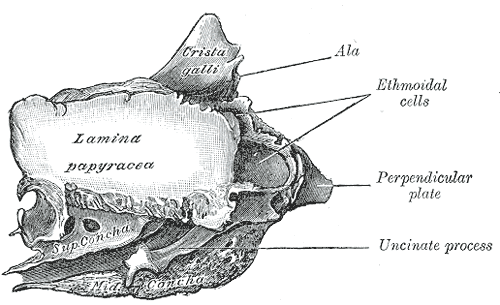
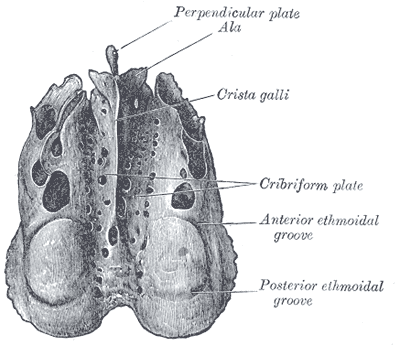
Structure
- Cribriform plate – sieve-like structure which forms the roof of the nasal cavity olfactory nerve fibres pass through the cribriform plate to innervate the nasal cavity with sense of smell
- Crista galli – superior bony projection from the cribriform plate which provides an attachment point for the falx cerebri
- Perpendicular plate – thin lamina projecting inferiorly from the cribriform plate, forming the superior two-thirds of the nasal septum
- Ethmoid labryinths (lateral masses) – large masses located at either side of the perpendicular plate which contain the ethmoidal sinuses.. Two sheets of bone form each labyrinth:
- Lamina papyracea (orbital plate) – paper-thin lateral surface of the ethmoid air cells, which also forms the principal component of the medial orbital wall
- Medial sheet – forms the upper lateral wall of the nasal cavity, from which the superior and middle conchae extend into the nasal cavity.
- Ethmoidal sinuses (air cells)- responsible for olfactory sensation, humidification, phonation and ventilation. It also influences drainage from the frontal and maxillary sinuses via the osteomeatal complex
- Superior and middle turbinate – arises from the ethmoidal lateral masses and become the superior and middle meatus
- The hiatus semilunaris separates the ethmoid bulla and the uncinate process. It constitutes the connection between the frontal and maxillary sinuses to the anterior ethmoidal cells
- Ostiometal complex
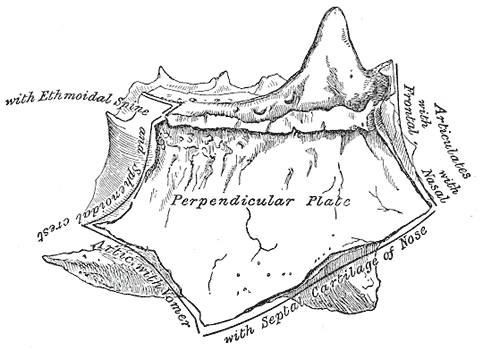
Articulations
The ethmoid articulates with 13 bones:
- Paired – nasal bones, maxillae, lacrimal bones, palatine bones, inferior conchae.
- Unpaired – frontal, vomer and sphenoid bones.
Blood Supply
- The sphenopalatine artery, branch of the superior labial artery, anterior and posterior ethmoidal arteries contribute to Kiesselbach’s plexus to supply blood to the nasal septum
- The superior and middle turbinates of the nasal septum receive their blood supply from the sphenopalatine artery and ethmoidal arteries
Nerves
- The ethmoidal cells, which are present in the ethmoid bone, are innervated by the anterior and posterior ethmoidal branches of the nasociliary nerve.
- The olfactory nerve arises from the caudal surface of the olfactory bulb and crosses the cribriform plate of the ethmoid bone to reach the nasal cavity.
Relations
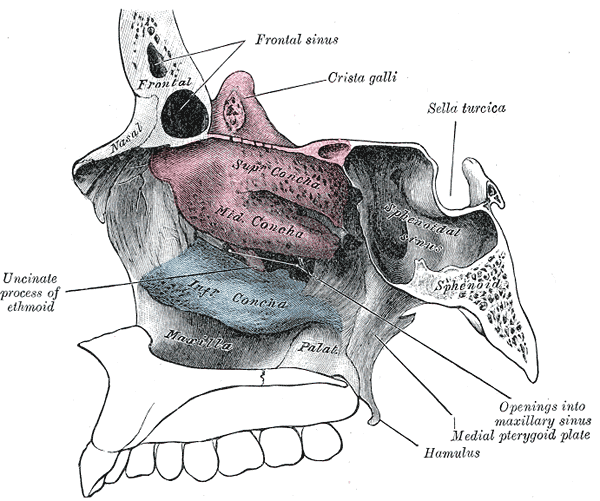
- The olfactory bulbs lies on two grooves lateral to the crista galli
Development
- The ethmoid bones develop primarily through endochondral ossification
- Starts to form at about 25 to 28 weeks of gestation
Variants
- Dehiscence of the lamina papyracea – defect of the medial orbital wall where orbital fat may protrude through to the ethmoid
References
Anatomy, Head and Neck, Ethmoid Bone
https://www.ncbi.nlm.nih.gov/books/NBK544328/
https://www.ncbi.nlm.nih.gov/books/NBK544328/