

Overview
The phrenic nerve is a bilateral, mixed nerve that originates from the cervical nerves in the neck and descends through the thorax to innervate the diaphragm. It is the only source of motor innervation to the diaphragm and therefore plays a crucial role in breathing.
Origin
Anterior rami of the cervical roots C3-5 at the lateral border of the anterior scalene muscle
- Spinal root C4 provides the main contribution, with lesser contributions from C3 and C5 and some communicating fibres from the cervical plexus.
Course
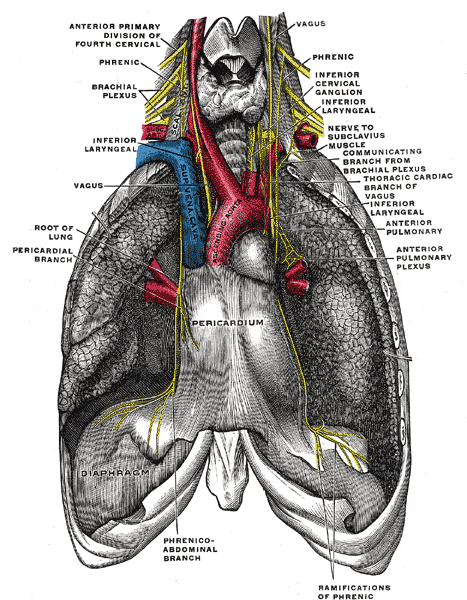
From it’s origin, it passes inferiorly over the anterior surface of the anterior scalene muscle, deep to the prevertebral layer of cervical fascia. On both sides, the nerve runs posterior to the subclavian vein. From here, the course of the phrenic nerve differs between the left and right:
Right Phrenic Nerve
- Passes anteriorly over the lateral part of the right subclavian artery
- Enters the thorax via the superior thoracic aperture
- Descends anteriorly along the right lung root
- Courses along the pericardium of the right atrium of the heart
- Pierces the diaphragm at the caval hiatus (level of T8), together with the inferior vena cava
- Innervates the inferior surface of the diaphragm
Left Phrenic Nerve
- Passes anteriorly over the medial part of the left subclavian artery
- Enters the thorax via the superior thoracic aperture
- Descends anterior to the left lung root
- Crosses the aortic arch and bypasses the vagus nerve
- Courses along the pericardium of the left ventricle of the heart
- Pierces and innervates the inferior surface of the diaphragm
Motor Functions
The phrenic nerve provides motor innervation to the ipsilateral hemi-diaphragm, the main muscle of respiration.
Sensory Function
- Central part of the diaphragm (peripheral diaphragm supplied by intercostal nerve)
- Central parts of diaphragmatic pleura and peritoneum
- Mediastinal pleura and the pericardium

Relations
Anterior
- Sternocleidomastoid muscle
- Inferior belly of omohyoid
- Internal jugular vein
- Transverse cervical artery
- Suprascapular artery
- Thoracic duct (for left phrenic only)
- Subclavian vein (at base of neck)
Posterior
- Scalenus anterior
- 2nd part of subclavian artery
- Hilar of both lungs
Medial
- Fibrous pericardium
- Great vessels of the heart (superior vena cava, thoracic aorta)
- Vagus nerve and sympathetic trunk
Anatomical Variants
- Anterior to the subclavian vein
- Courses along the lateral border of the anterior scalene muscle
- May pierce the anterior scalene muscle
- Accessory phrenic nerve (usually arising from the ansa cervicalis or subclavian nerve)
- May receive additional branches from the cervical or brachial plexuses
- May supply a branch to the subclavius muscle