

Overview
A major vein returning deoxygenated blood from the brain, upper face and neck
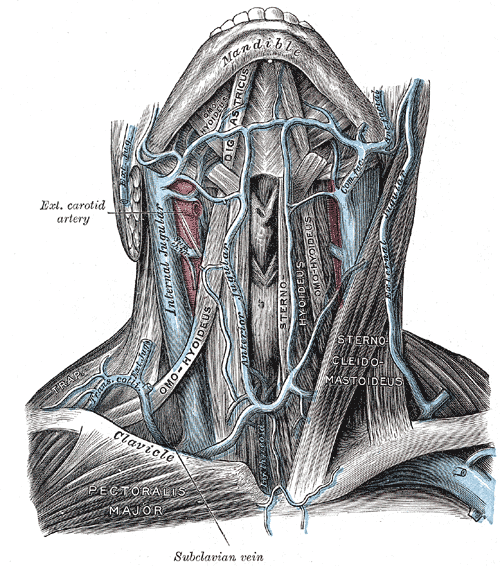
Origin
Formed by the union of inferior petrosal and sigmoid venous sinus, forming the jugular bulb in the jugular foramen (formed by the petrous temporal bone and occipital bone).
Course
- Descends through neck within the carotid sheath with internal carotid artery, separated by the vagus nerve
- Descends between the two heads (sternal and clavicular) of the sternocleidomastoid muscle
Termination
- Joins the subclavian artery to form the brachiocephalic vein

Tributaries
- Inferior petrosal sinus – drains cavernous sinus to jugular bulb
- Sigmoid dural venous sinus – formed by sigmoid sinus and superior petrosal sinus
- Pharyngeal veins
- Common facial vein – formed by facial and retromandibubular vein
- Lingual vein – formed by the sublingual, deep lingual and dorsal lingual vein
- enters IJV near greater horn of hyoid bone
- Superior thyroid
- Middle thyroid
(Note: inferior thyroid vein drains into brachiocephalic vein directly)
Relations
- Surrounded by accompanying deep cervical lymph nodes
- Relation to internal carotid artery
- C2: Posteriorly
- C3: Posterolaterally
- C4: Laterally
- Vagus nerve (CN X) always situated between the internal carotid artery and internal jugular vein
- Anterior:
- Upper third: spinal root of accessory nerve
- Middle third: lower root of ansa cervicalis
- Lower third: sternocleidomastoid muscle, tendon of omohyoid muscle
- Posteriorly (from superior to inferior as the IJV descends in the neck)
- Lateral mass of atlas (C1)
- Middle scalene muscle
- Anterior scalene muscle
- Pleura of lung apices
Anatomical Variants
- High jugular bulb
- External jugular dominance
- Unusual tributaries