

Overview
The lumbar plexus is a network of nerve fibres arising from the lumbar spinal cord, which supplies the skin and musculature of the lower limb.
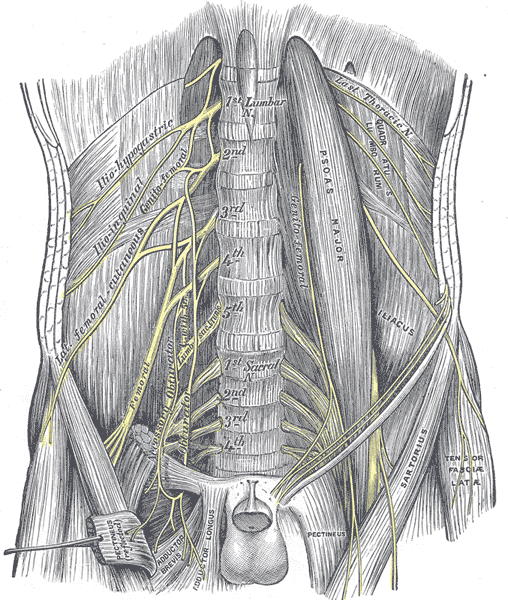
Origin
The paired mixed spinal nerves (formed by the combination of dorsal and ventral roots in the vertebral canal) leave the spinal cord via the intervertebral foramina of the vertebral column, then divides into the dorsal (posterior) and ventral (anterior) rami.
The lumbar plexus is formed by the anterior rami of the lumbar spinal nerves L1, L2, L3 and L4 with contributions from T12, which merge in the substance of the psoas major to form branches.
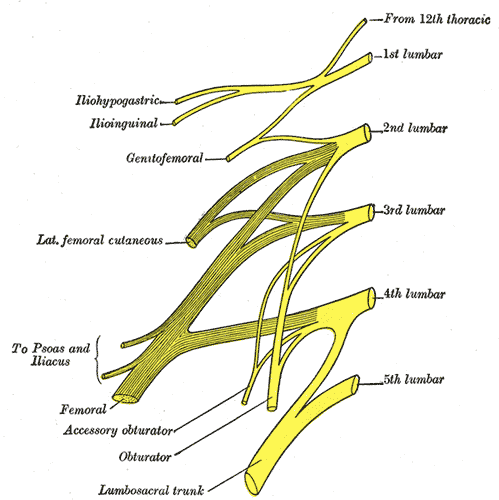
Branches
Iliohypogastric Nerve
- Course: Runs to the iliac crest, across the quadratus lumborum muscle of the posterior abdominal wall. It then perforates the transversus abdominis, and divides into its terminal branches
- Roots: L1 with contributions from T12
- Motor supply: Internal oblique and transversus abdominis
- Sensory supply: Posterolateral gluteal skin in the pubic region
Ilioinguinal Nerve
- Course: Follows the same anatomical course as the larger iliohypogastric nerve. After innervating the muscles of the anterior abdominal wall, it passes through the superficial inguinal ring to innervate the skin of the genitalia and middle thigh.
- Roots: L1
- Motor supply: Internal oblique and transversus abdominis
- Sensory supply: Skin on the superior antero-medial thigh. In males, it also supplies the skin over the root of the penis and anterior scrotum. In females, it supplies the skin over mons pubis and labia majora.
Genitofemoral Nerve
- Course: After leaving the psoas major muscle, the genitofemoral nerve quickly divides into a genital branch, and a femoral branch
- Roots: L1, L2
- Motor supply: Cremasteric muscle
- Sensory supply:
- Genital branch: Skin of the anterior scrotum (in males) or the skin over mons pubis and labia majora (in females).
- Femoral branch: Skin on the upper anterior thigh.
Lateral Cutaneous Nerve of the Thigh
- Course: Enters the thigh at the lateral aspect of the inguinal ligament, where it provides cutaneous innervation to the skin there.
- Roots: L2, L3
- Motor supply: None – this nerve has a purely sensory function
- Sensory supply: Anterior and lateral thigh down to the level of the knee
Obturator Nerve
- Course: After descending within the psoas muscle, it emerges from its medial margin to enter the pelvis. It follows the lateral wall of the pelvis, passing through the obturator canal with the obturatory artery and vein, then enters the medial compartment of the thigh.
- Roots: L2, L3, L4
- Motor supply: Muscles of the medial thigh – the obturator externus, adductor longus, adductor brevis, adductor magnus and gracilis
- Sensory supply: Skin over the medial thigh
Femoral Nerve
- Roots: L2, L3, L4
- Motor supply: Muscles of the anterior thigh – the illiacus, pectineus, sartorius and quadriceps femoris
- Note: The psoas major is innervated by anterior rami of L1-3
- Sensory supply: Skin on the anterior thigh and the medial leg
Relations
Lateral to psoas major muscle
- Iliohypogastric
- Ilioinguinal
- Lateral femoral cutaneous nerve of thigh
- Femoral nerve
Anterior to belly of psoas major muscle
- Genitofemoral nerve (L1-2)
Medial to psoas major muscle
- Lumbosacral trunk
- Obturator nerve
Anatomical Variants
- Absent iliohypogastric nerve (~20%)
- Early branching (within psoas muscle) of the genitofemoral nerve (~20%)
- Accessory obturator nerve (~10%)
- Lateral femoral cutaneous nerve arising as a branch of the femoral nerve