

Overview
The stomach is a J-shaped intraperitoneal organ of the upper gastrointestinal tract, predominantly located in the epigastric and umbilical abdominal regions.
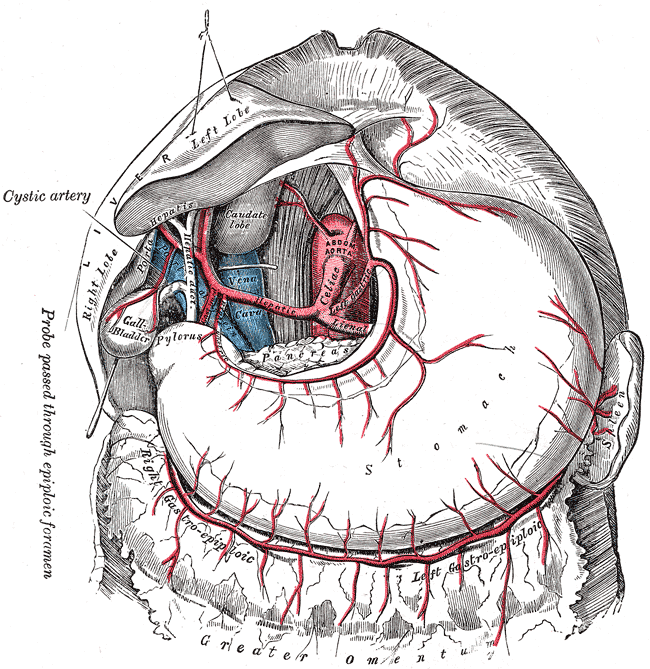
Gross Anatomy
- Cardia – superior opening surrounding gastro-oesophageal junction at T11 level.
- Fundus – rounded portion superior and to left of cardia.
- Body – central portion inferior to fundus. The angular notch on the lesser curvature of the stomach delineates junction of body and pylorus.
- Pylorus – distal portion of stomach, connects to duodenum. It is divided into the pyloric antrum, pyloric canal and pyloric sphincter (demarcates the transpyloric plane at L1 level).
Features
- Greater curvature – formed by long convex lateral border of stomach, which arises at cardiac notch and continues inferiorly to pyloric antrum. The greater omentum hangs down from stomach. Supplied by short gastric, right and left gastro-omental arteries.
- Cardiac notch – the acute angle where the left margin of the stomach joins the greater curvature
- Lesser curvature – formed by short concave medial border of stomach. Attaches to the liver via the hepatogastric ligament. Supplied by left and right gastric branches of hepatic artery.
- Greater omentum – large apron-like fold of visceral peritoneum that hangs from the greater curvature to cover the small bowel and folds back to ascend to the transverse colon before continuing to the posterior abdominal wall.
- Lesser omentum – small peritoneal fold arises at the lesser curvature and ascends to attach to the liver. Contains the portal triad at its free right border.
Innervation
- Parasympathetic nerve – supply arises from the anterior and posterior vagal trunks, derived from the vagus nerve.
- Sympathetic nerve – supply arises from the T6-T9 spinal cord segments and passes to the coeliac plexus via the greater splanchnic nerve. It also carries some pain transmitting fibres.
Arterial Supply
- Lesser curvature: Right gastric artery (inferiorly, branch of the proper hepatic artery) and left gastric artery (superiorly, branch of the coeliac trunk).
- Cardia: Left gastric artery – branch of the coeliac trunk
- Greater curvature: Right gastroepiploic artery (inferiorly, branch of the gastroduodenal artery) and left gastroepiploic artery and short gastric arteries (superiorly, both branches of splenic artery).
- Fundus of the stomach: Short gastric arteries – branches of the splenic artery
Venous Drainage
- Left and right gastric veins drain to the portal vein
- Short gastric vein and left gastroepiploic vein drain to splenic vein.
- Right gastroepiploic vein drains to superior mesenteric vein.
Lymphatic Drainage
Routes of flow of lymph from perigastric nodes to para-aortic lymph nodes include:
- Directly to left paracardial lymph nodes
- Along lymph nodes accompanying the splenic artery
- Along lymph nodes accompanying the celiac artery
- Along lymph nodes accompanying the superior mesenteric artery
- Along lymph nodes on the posterior surface of the pancreatic head and nodes accompanying the common hepatic artery
Ultimately these empty into the gastric and gastroomental lymph nodes. The pyloric part drain by the pyloric lymph nodes which empty into the coelic lymph nodes.
Relations
- Superior: oesophagus, left hemidiaphragm
- Anterior: diaphragm, greater omentum, anterior abdominal wall, left lobe of liver and gallbladder
- Posterior: lesser sac, pancreas, kidney, left adrenal gland, spleen, splenic artery, transverse mesocolon
- Medially: abdominal aorta, coeliac trunk, coeliac lymph nodes
Anatomical Variants
- Micrograstria – associated with malrotation, asplenic, skeletal/cardiac/renal/tracheoesophageal anomaly
- Atresia
- Duplication of the oesophagus
- Heterotropic pancreas