

Overview
The hypoglossal nerve is the twelfth cranial nerve and has a purely somatic motor function, innervating all intrinsic and extrinsic muscles of the tongue (except the palatoglossus which is innervated by the vagus nerve).

Origin
A dozen roots from the hypoglossal nucleus arise laterally in the lower anterolateral sulcus, separating the olive and pyramid, in the medulla oblongata of the brainstem

Course & Relations
- From the medulla, the hypoglossal nerve passes laterally across the posterior cranial fossa within the subarachnoid space
- It splits in two before exiting the cranium via the hypoglossal canal of the occipital bone
- Within the hypoglossal canal it reforms to a single trunk
- As it exits the cranium, it enters the retrostyloid space (part of the lateral pharyngeal space)
- Extracranially, it receives a branch of the cervical plexus (fibres from anterior rami of C1-C2 spinal nerve roots) which travels within the same sheath to later innervate the suprahyoid and infrahyoid muscles.
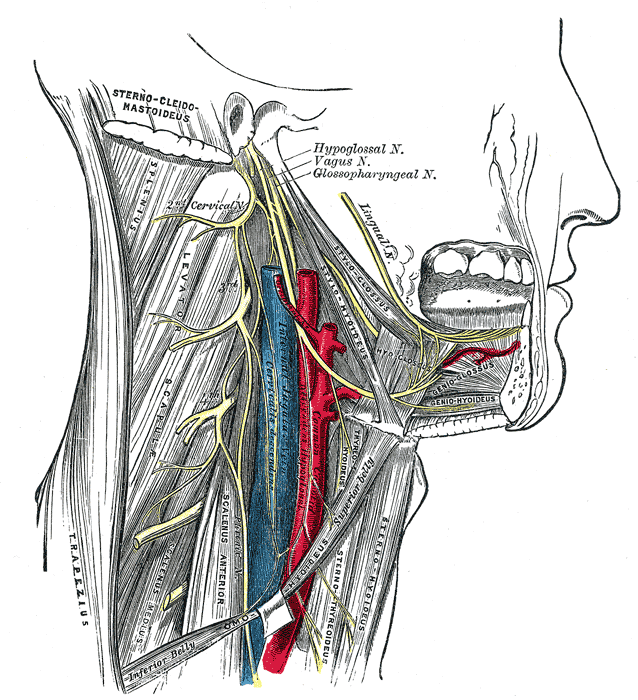
- The hypoglossal nerve then descends vertically within the carotid sheath through the retrostyloid space, initially medial to the internal carotid artery and later laterally, such that it lies between the internal jugular vein and internal carotid artery
- It lies posterior to the vagus nerve and glossopharyngeal nerve.
- At the level of the origin of the occipital artery, it turns horizontally to course anteriorly towards the tongue, crossing over the carotid triangle, and then over the submandibular triangle of the neck.
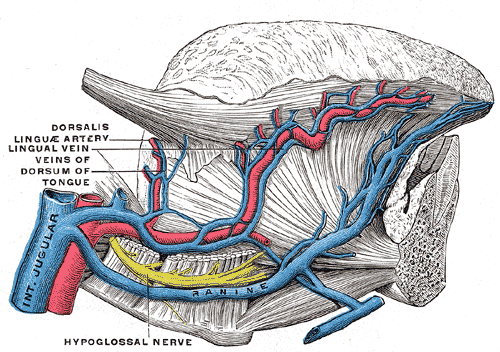
- In doing so, it crosses the internal carotid artery and external carotid artery, coursing anteriorly between the stylohyoglossus (superficially) and hyoglossus (deep) to innervate the underneath of the tongue
Branches & Supply
There are four branches:
- Meningeal branch – Returns to the skull through the hypoglossal canal and innervates the dura mater on the floor of the posterior cranial fossa
- Superior root of the ansa cervicalis – supplies three of the infrahyoid muscles, which all act to depress the hyoid bone
- Sternohyoid
- Sternothyroid
- Omohyoid
- Terminal lingual nerves – innervate intrinsic muscles of the tongue (superior longitudinal, inferior longitudinal, transverse and vertical), extrinsic muscles of the tongue (genioglossus, hyoglossus and styloglossus)
- Nerve to geniohyoid and thryohyoid via C1
- Geniohyoid – suprahyoid muscle
- Thyrohyoid – infrahyoid muscle
Muscles supplied
The hypoglossal nerve innervates all the intrinsic and all but one of the extrinsic muscles (palatoglossus innervated by vagus nerve) of the tongue
.
Extrinsic Muscles
- Genioglossus – Draw the tongue forward from the root
- Hyoglossus – Retracts the tongue and depresses its side
- Styloglossus – Draws the tongue upward
Intrinsic Muscles
Changes the shape of the tongue such as shortening, narrowing, curving the tongue.
- Superior longitudinal
- Inferior longitudinal
- Transverse
- Vertical
Suprahyoid
- Geniohyoid – Elevates the hyoid bone
Surgical considerations
- At high risk of injury during carotid endartectomy