

Overview
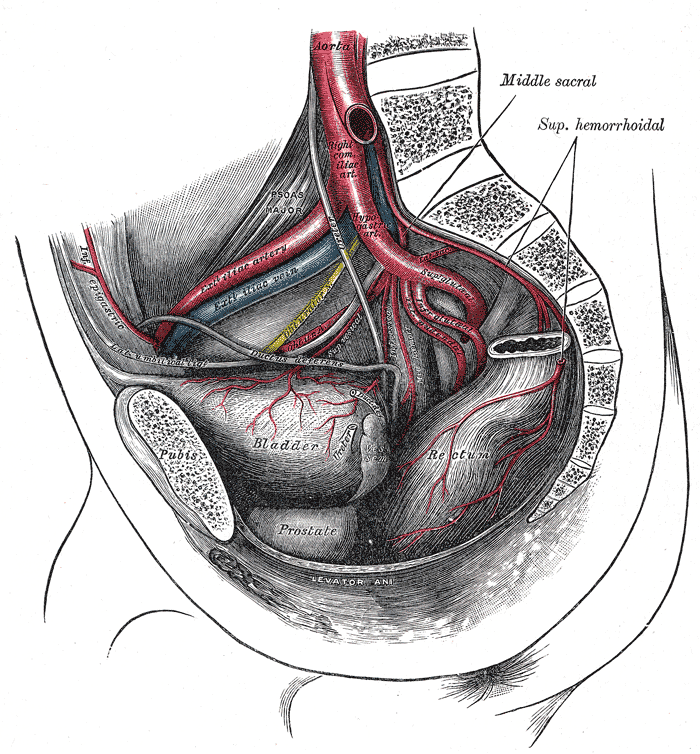
The internal iliac artery (less commonly known as the hypogastric artery) is the smaller terminal branch of the common iliac artery. It supplies the pelvic walls, pelvic viscera, external genitalia, perineum, buttock and medial part of the thigh.

Origin
The common iliac artery bifurcates into the internal iliac artery and external iliac artery at the level of the pelvic brim anterior to the sacroiliac joint.
Course
- The internal iliac artery descends and courses approximately 4cm posteromedially to enter the true pelvis (lesser pelvis)
- True pelvis – is the space enclosed by the pelvic girdle and pelvic brim, i.e. the space between the pelvic inlet (plane between sacral promontory to the pubic crest) and the pelvic floor
- At the superior margin of the greater sciatic foramen it divides into an anterior division and posterior division
- The anterior division continues anteriorly along the lateral pelvic wall to the ischial spine anterior to piriformis
- The posterior division runs posteriorly along the pelvic wall and gluteal region
Branches & Supply
Anterior division
The anterior division gives off both visceral and parietal branches:
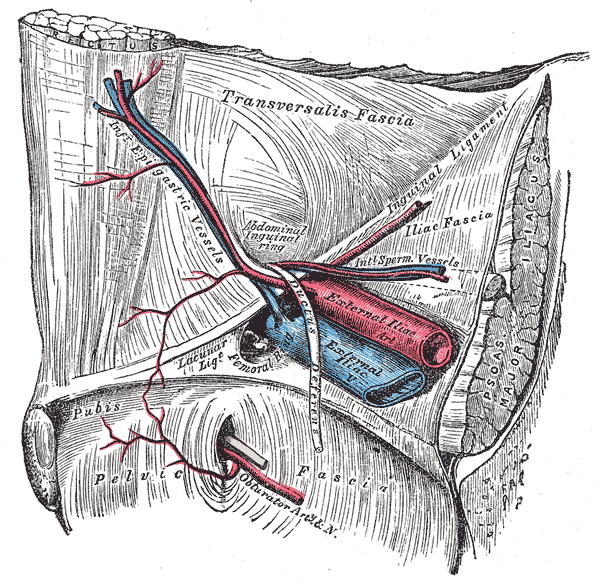
- Obturator artery – travels through the obturator canal with the obturator nerve and vein
- The obturator canal is a small opening in the superior aspect of the obturator foramen that connects the pelvis to the medial compartment of the thigh
- The anterior branch supplies obturator externus, pectineus, adductor longus/medius/brevis, and gracilis muscle, and anastomoses with the posterior branch and with the medial femoral circumflex artery.
- Umbilical artery – obliterated, as only patent in the foetus, transports deoxygenated blood from foetus to the placenta. Gives rise to:
- Superior vesical artery – supplies the superior aspect of the urinary bladder and gives rise to the artery to the vas deferens (male)
- Vaginal artery (female) – descends to the vagina supplying branches to the inferior bladder and rectum
- Inferior vesical artery – supplies the inferior bladder. In males, supplies the prostate gland and seminal vesicle
- Uterine artery (female) – travels within the cardinal ligament to reach the cervix where it ascends along the lateral aspect of the uterus. At the origin of the fallopian tubes, it anastomoses with the ovarian artery (direct branch of the abdominal aorta at L2).
- Middle rectal artery – travels medially to supply the part of inferior third of the rectum. It also forms anastomoses with the superior rectal artery (derived from the inferior mesenteric artery) and the inferior rectal artery (derived from the internal pudendal)
- Internal pudendal artery – Moves inferiorly to exit the pelvis via the greater sciatic foramen. Accompanied by the pudendal nerve, it curves around the sacrospinous ligament then enters the perineum via the lesser sciatic foramen. It is the main artery responsible for the blood supply to the perineum. Gives off branches which supplies the external genitalia and also:
- Inferior rectal artery – supplies part of inferior third of the rectum
- Inferior gluteal artery – terminal branch of the anterior trunk. It leaves the pelvic cavity via the greater sciatic foramen, emerging inferiorly to the piriformis muscle in the gluteal region. It contributes to the blood supply of the gluteal muscles and hip joint.
Note: the obturator, internal pudendal and inferior gluteal arteries are parietal branches, whereas the other arteries are visceral arteries (i.e. umbilical, superior and inferior vesical, vaginal, uterine and middle rectal artery).
Posterior division
The posterior division only gives rise to parietal branches:
- Iliolumbar artery – Ascends to exit the lesser pelvis, dividing into a lumbar and iliac branch.
- Lumbar branch – supplies psoas major, quadratus lumborum and the posterior abdominal wall
- Iliac branch – supplies the muscles and bone around the iliac fossa
- Lateral sacral arteries (superior and inferior branches) – Travels inferomedially along the posterior pelvic wall to supply structures in the sacral canal, and the skin and muscle posterior to the sacrum.
- Superior gluteal artery – terminal branch of the posterior division, running betweeing the lumbosacral trunk and first sacral trunk. It exits the pelvic cavity via the greater sciatic foramen, entering the gluteal region superiorly to the piriformis muscle. It is the major blood supply to the muscles and skin of the gluteal region.
Relations
- Anteriorly: ureter, ovary, fallopian tube
- Posteriorly: internal iliac vein, lumbosacral trunk, sacroiliac joint
- Medially: peritoneum, ureter (the pararectal space lies between the ureter and the internal iliac artery)
- Laterally: external iliac vein, obturator nerve
Anatomical Variants
- Persistent sciatic artery
- Corona mortis
- Obturator artery branches off the inferior epigastric artery (arising from the external iliac artery)
- Prostatic artery arising from inferior vesical artery
- Middle rectal artery arising from inferior vesical artery
- Middle rectal artery arising from common origin with inferior vesical
- Inferior gluteal and internal pudendal sharing common origin
- Accessory obturator arteries (may arise from inferior epigastric)